Gold is one of the most actively watched markets in the world. New Zealand traders follow it because it reacts to global risk, inflation expectations, central bank policy, US dollar strength, interest rates, and investor demand. But “trading gold” can mean several different things. It can mean trading XAU/USD on a CFD platform like MT5, buying a gold ETF, investing in physical bullion, trading gold futures, or buying shares in gold mining companies.
For beginners, the key is to understand the instrument before thinking about the trade. A gold CFD is not the same as owning a gold bar. A gold ETF is not the same as trading XAU/USD with leverage. A futures contract is not the same as buying a small amount of physical gold. Each method has different costs, risks, time horizons, and practical uses.
This guide is written for New Zealand traders who want a clear, educational overview of how gold trading works. It explains the main ways to access gold, how XAU/USD is quoted, what moves the gold price, how NZD/USD affects local traders, what to check before using a provider, and how to think about risk before placing a trade.
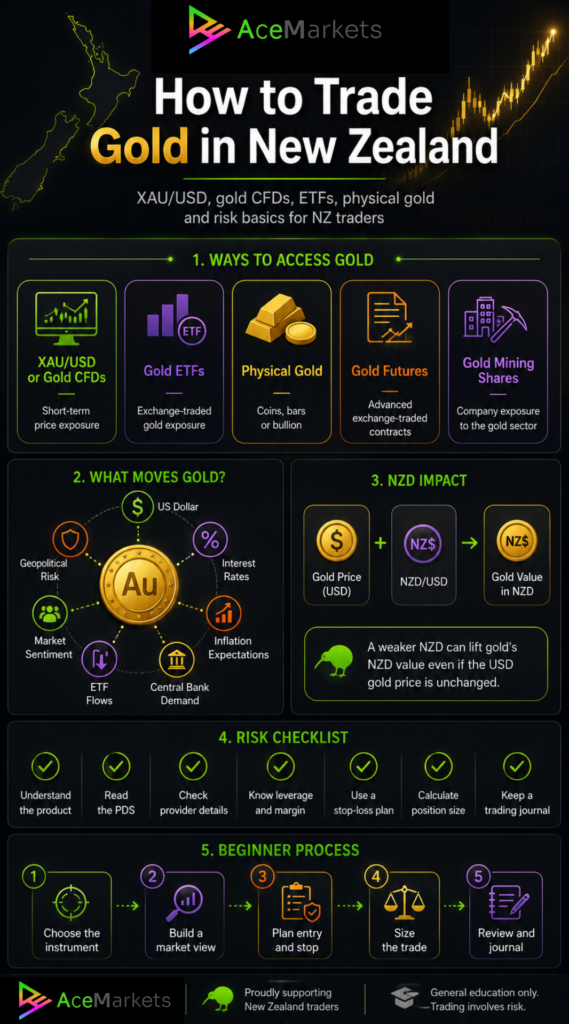
Quick Answer: How Do You Trade Gold in New Zealand?
New Zealand traders can trade or invest in gold through gold CFDs, XAU/USD, gold ETFs, physical bullion, gold futures, or gold mining shares. Active traders often focus on XAU/USD or gold CFDs because these instruments allow exposure to gold price movements without owning physical metal. Investors may prefer ETFs, bullion, or mining shares depending on their objectives, time horizon, costs, and risk tolerance.
The FMA notes that commodities such as gold can be bought directly from a dealer, accessed through managed funds, or accessed through derivatives or shares of listed commodity-producing companies. The same FMA guidance also warns that commodities are not low risk and that direct commodity investments do not pay interest or dividends.
What Does “Trading Gold” Mean?
Gold trading means taking a position based on the price movement of gold. A trader may buy if they expect the price to rise or sell short through a derivative if they expect the price to fall. The trader is focused on price movement, timing, risk control, and trade management.
Gold investing is different. Investors usually focus on longer-term exposure through physical gold, ETFs, or shares in gold-related companies. Their time horizon may be months or years rather than minutes, hours, or days.
The most common trading symbol for spot gold is XAU/USD. “XAU” represents one troy ounce of gold, and “USD” represents the US dollar. When traders say gold is trading at a certain price, they are usually referring to the US dollar price per troy ounce. The World Gold Council states that gold prices are quoted in currency units per troy ounce unless otherwise stated, and the LBMA Gold Price is widely used as an important benchmark throughout the gold market.
Example
If XAU/USD is quoted at 2,400, this means one troy ounce of gold is priced at US$2,400. If the price moves from 2,400 to 2,420, gold has increased by US$20 per ounce. Whether that movement produces a gain or a loss depends on the position direction, position size, fees, spread, currency conversion, and risk controls.
Main Ways to Access Gold in New Zealand
New Zealand traders and investors have several ways to access gold. The right method depends on whether the goal is short-term trading, long-term exposure, physical ownership, portfolio diversification, or learning how gold reacts to macroeconomic events.
| Method | What it is | Typical user | Main advantages | Main risks |
|---|---|---|---|---|
| Gold CFDs / XAU/USD | A derivative that tracks gold price movement | Active traders | Long or short exposure, margin-based, no storage | Leverage, margin calls, spread, overnight costs, counterparty risk |
| Gold ETFs | Exchange-traded funds with gold exposure | Investors | Simple market access, no physical storage | Market risk, tracking risk, fees, currency exposure |
| Physical gold | Coins, bars, or bullion | Long-term holders | Direct ownership, tangible asset | Storage, insurance, dealer premiums, liquidity, tax complexity |
| Gold futures | Exchange-traded futures contracts | Advanced traders | Deep liquidity, transparent exchange pricing | High notional exposure, margin risk, expiry, complexity |
| Gold mining shares | Shares of gold producers or explorers | Equity investors | Potential company growth exposure | Company risk, operational risk, equity market risk |
Gold CFDs and XAU/USD
Gold CFDs allow traders to speculate on gold price movement without owning the underlying metal. This can make them flexible for active traders, but it also introduces leverage and counterparty risk. CFD trading requires strong risk management because relatively small price movements can have a large effect on account equity when leverage is used.
For New Zealand traders, the regulatory context matters. The FMA states that a derivatives issuer making a regulated offer of derivatives must be licensed by the FMA, and regulated derivative offers must provide disclosure through a Product Disclosure Statement and the Disclose Register.
Gold ETFs
Gold ETFs are usually more suited to investors than short-term traders. They provide market exposure to gold without requiring the investor to store coins or bars. In New Zealand, one local example is the Smart Gold ETF, which states that it invests in the iShares Gold Trust and seeks to reflect the performance of the price of gold.
The NZX lists Smart Gold ETF units under the instrument name “Smart Gold ETF Units”, with the ticker GLD and the type “Exchange Traded Funds”.
Physical Gold
Physical gold means buying bullion, coins, or bars from a dealer. This is direct ownership rather than trading a price contract. It may appeal to investors who want a tangible asset, but it comes with practical costs. The FMA notes that direct commodity investments do not pay interest or dividends, and that storage, insurance, and tax may need to be considered.
Physical gold also has liquidity considerations. The price you pay from a dealer may include a premium above spot, and the price you receive when selling may be below spot or subject to a dealer spread. A trader who wants fast entry and exit may find physical bullion less practical than a market-traded instrument.
Gold Futures
Gold futures are standardised exchange-traded contracts. They are generally more suitable for advanced traders because the contract size and margin requirements can create substantial exposure. CME’s COMEX gold futures rules state that the contract unit is 100 troy ounces and that prices are quoted in dollars and cents per troy ounce.
Futures can provide transparent exchange pricing, but they are not usually the first step for a beginner. Traders need to understand expiry, margin, contract specifications, liquidity, rollovers, and potential delivery mechanics.
Gold Mining Shares
Gold mining shares are not the same as gold. A mining company may benefit from higher gold prices, but its share price can also be affected by production costs, debt, management decisions, exploration results, geopolitical exposure, and broader equity market conditions.
Mining shares may suit investors who understand company analysis, but they introduce equity-specific risks that do not exist in a pure gold price trade.
Is Gold Trading Legal in New Zealand?
Gold trading is available in New Zealand, but the product type and provider matter. If a provider is offering regulated derivatives to New Zealand retail investors, the FMA licensing and disclosure framework becomes important. The FMA says individuals or businesses offering forex contracts linked to exchange rates must hold a derivatives issuer licence, and licensed derivatives providers must give a Product Disclosure Statement before trading.
For gold CFDs and similar derivative products, traders should check:
| Item to check | Why it matters |
|---|---|
| FMA licensing | Helps confirm whether the provider is authorised for relevant services in New Zealand. |
| FSPR registration | Shows registered financial service provider information. |
| PDS | Explains the product, risks, fees, counterparty exposure, and terms. |
| Product schedule | Shows spreads, margin, trading hours, financing, and contract details. |
| Risk disclosure | Explains how losses can occur. |
| Complaints process | Shows how disputes are handled. |
| Client money handling | Helps traders understand how funds are held. |
The Companies Office explains that before applying to the FMA for a licence, a provider must be registered or preparing to register as a financial service provider on the FSPR, and licensed services display on FSP registration once the FMA has approved the licence.
This section should be treated as educational context, not legal advice. Traders should check the current FMA register, read the PDS, and consider independent professional guidance where needed.
What Moves the Gold Price?
Gold is influenced by a mix of macroeconomic, market, and behavioural factors. It does not produce cash flow like a company share, and it does not pay interest like a bank deposit. That means price is often driven by investor demand, currency movements, interest-rate expectations, inflation expectations, geopolitical risk, and broader market sentiment.
1. US Dollar Strength
Gold is commonly quoted in US dollars. When the US dollar strengthens, gold may become more expensive for buyers using other currencies. When the US dollar weakens, gold may become relatively cheaper for non-US buyers. This relationship is not perfect, but it is important.
For New Zealand traders, this means gold has two layers: the global XAU/USD price and the local NZD conversion. A trader may be right about gold in USD but still affected by NZD/USD movement.
2. Interest Rates and Real Yields
Gold does not pay income. When interest rates and real yields rise, income-producing assets can become more attractive relative to gold. When real yields fall, gold may become more attractive because the opportunity cost of holding a non-yielding asset is lower.
CME lists US macro references such as Non-Farm Payrolls, GDP, CPI, FOMC interest-rate decisions, and the US Dollar Index as important reference points for gold markets.
3. Inflation Expectations
Gold is often discussed as an inflation hedge, but it does not move in a straight line with inflation. Markets usually care about expected inflation, central bank reactions, real rates, and the credibility of monetary policy. For traders, the market reaction to inflation data can matter more than the headline number itself.
4. Geopolitical and Financial Risk
Gold is often treated as a safe-haven asset. During periods of war, financial stress, banking uncertainty, or sharp equity-market volatility, some investors may seek exposure to gold. This does not guarantee gold will rise during every crisis, but it explains why gold often becomes more closely watched during uncertain periods.
5. Central Bank Demand
Central banks hold gold as part of reserve management. Their buying and selling can influence long-term demand. The World Gold Council reported that total gold demand in 2025, including over-the-counter demand, exceeded 5,000 tonnes for the first time, while central bank purchases reached 863 tonnes.
6. ETF and Investment Demand
Gold ETFs can create meaningful investment flows. When ETF inflows rise, gold demand may receive support. When ETFs experience outflows, gold may face pressure. The World Gold Council reported that global gold ETF holdings grew by 801 tonnes in 2025, which it described as the second strongest year on record.
7. Supply, Mining and Recycling
Gold supply changes slowly compared with some commodities. New mine supply, recycling, production costs, and producer hedging can all matter, but gold’s price is often more sensitive to investment demand and macroeconomic expectations than to short-term physical supply changes.
How NZD/USD Affects Gold Traders in New Zealand
Because gold is usually quoted in USD per troy ounce, New Zealand traders need to understand currency conversion.
Simple Example
Assume gold is US$2,400 per ounce.
If NZD/USD is 0.6000, then:
US$2,400 ÷ 0.6000 = NZ$4,000 per ounce.
If gold stays at US$2,400 but NZD/USD falls to 0.5700, then:
US$2,400 ÷ 0.5700 = NZ$4,210.53 per ounce.
In this example, the USD gold price did not move, but the NZD value of gold increased because the New Zealand dollar weakened against the US dollar.
For traders, this matters in three ways:
| Area | Why it matters |
|---|---|
| Account currency | Gains and losses may be converted into NZD. |
| Product pricing | Some platforms quote XAU/USD, while local portfolio value may be NZD. |
| Risk management | A position can be affected by both gold movement and currency conversion. |
Best Time to Trade Gold from New Zealand
Gold trading hours depend on the instrument. Gold CFDs and spot-style products often follow extended global weekday trading hours, but exact hours depend on the provider’s product schedule. Gold futures provide nearly 24-hour electronic access, according to CME’s product information.
For New Zealand traders, liquidity often becomes more active when London and New York markets are open. This can fall in the evening or overnight New Zealand time, depending on daylight saving. The most active period may also bring wider price movement, faster reactions to news, and higher execution risk.
If trading an NZX-listed product such as a gold ETF, local exchange hours matter. NZX states that the regular cash market trading session runs continuously from 10:00am until 4:45pm every trading day.
How to Trade Gold in New Zealand: Step-by-Step
Step 1: Decide Whether You Are Trading or Investing
Start by defining the purpose of the gold exposure.
A trader may focus on short-term price movement, using charts, economic events, and risk controls. An investor may want longer-term exposure through ETFs, physical bullion, or gold-related equities.
Write down the purpose before choosing the instrument.
Step 2: Choose the Instrument
Choose the instrument that matches the objective.
| Goal | Possible instrument |
|---|---|
| Short-term gold price trading | XAU/USD or gold CFD |
| Long-term gold exposure without storage | Gold ETF |
| Tangible ownership | Physical bullion |
| Advanced exchange-traded speculation | Gold futures |
| Company-growth exposure | Gold mining shares |
A beginner should understand the simplest version first. For active traders, that usually means learning how XAU/USD pricing, spreads, margin, and position sizing work before using leverage.
Step 3: Check the Provider and Product Documents
Before trading derivatives, check whether the provider is properly licensed for the relevant New Zealand service, read the PDS, and understand the terms. The FMA specifically tells New Zealanders to check they are using a New Zealand-licensed provider and to read the PDS before trading.
Review:
| Document or detail | What to look for |
|---|---|
| PDS | Product mechanics, fees, risks, counterparty information |
| Product schedule | Spread, margin, trading hours, financing |
| Order policy | Stop-loss, limit orders, slippage, execution |
| Client money policy | How funds are held |
| Margin policy | Margin calls, close-out rules, leverage |
| Complaints process | Dispute procedure |
Step 4: Learn the Contract Specifications
A gold product can look simple on the chart while being complex in account impact.
Check:
- What one lot or one unit represents.
- Minimum trade size.
- Tick value or price movement value.
- Margin requirement.
- Spread.
- Commission.
- Overnight financing or swap.
- Trading hours.
- Stop distance rules.
- Whether the product can gap.
Never assume one platform’s gold product works the same way as another.
Step 5: Build a Basic Market View
A gold trader should understand both the macro picture and the chart picture.
A basic market view may include:
| Analysis area | Example questions |
|---|---|
| Trend | Is gold making higher highs and higher lows? |
| Support and resistance | Where has price previously reacted? |
| Volatility | Is price moving calmly or sharply? |
| USD direction | Is the US dollar rising or falling? |
| Interest-rate expectations | Are markets expecting rate cuts or hikes? |
| News calendar | Are CPI, Fed, jobs data, or geopolitical events ahead? |
| Sentiment | Are investors seeking risk or safety? |
This does not need to be complex. The goal is to avoid trading blindly.
Step 6: Define Entry, Stop, Risk and Exit
Before entering a trade, define:
| Plan item | Example |
|---|---|
| Direction | Buy gold if price breaks above resistance |
| Entry | Enter only after candle closes above level |
| Stop-loss | Place below recent support or volatility level |
| Risk amount | Risk a fixed percentage or fixed dollar amount |
| Take-profit | Use next resistance zone or risk-reward target |
| Exit rule | Exit if the setup fails or news risk changes |
The most important part is the loss plan. A trader who knows where they are wrong can control risk better than a trader who only focuses on the upside.
Step 7: Calculate Position Size
Position size connects the trade idea to account risk.
Example:
A trader has a NZ$5,000 account and decides that the educational risk example is NZ$50 on one trade. The planned stop distance is US$10 per ounce. Ignoring spread, slippage, fees, and currency conversion for simplicity, the maximum theoretical exposure would be:
NZ$50 risk ÷ US$10 stop distance = approximately 5 ounces, adjusted for exchange rate and product contract value.
In real trading, the trader must account for the exact product specification, NZD/USD conversion, margin, spread, financing, and platform rules.
Step 8: Place the Trade and Monitor It
Once the trade is placed, monitor it according to the plan. Avoid moving the stop further away simply because the trade is uncomfortable. If the trade thesis changes, exit based on the plan rather than emotion.
Step 9: Keep a Trading Journal
A gold trading journal should record:
| Journal field | Why it matters |
|---|---|
| Date and time | Shows when setups work or fail |
| Instrument | XAU/USD, ETF, CFD, futures |
| Direction | Long or short |
| Entry and exit | Measures execution quality |
| Stop and target | Reviews planning discipline |
| Reason for trade | Identifies whether setup was valid |
| News context | Tracks macro sensitivity |
| Result | Measures performance |
| Lesson | Improves future decisions |
A journal helps traders separate strategy quality from short-term outcomes.
Practical Gold Trading Example
This example is educational only.
A New Zealand trader is watching XAU/USD after US inflation data. Gold has been moving sideways between 2,390 and 2,420. The trader does not want to guess inside the range. Instead, they create two possible plans.
Plan A: Breakout Trade
- If gold closes above 2,420 with strong momentum, the trader looks for a long setup.
- The stop is placed below the breakout level or below a short-term support zone.
- The target is the next resistance area.
- The trade is skipped if the breakout happens just before major news.
Plan B: Range Rejection Trade
- If gold moves toward 2,420 but rejects the level, the trader looks for signs of selling pressure.
- The stop is placed above the rejection high.
- The target is near the middle or lower part of the range.
- The position size is reduced if volatility is high.
Both plans are valid only if the trader understands the product, risk, spread, and market conditions. The key is that the trader has rules before entering.
Technical Analysis Tools for Gold Traders
Technical analysis can help traders organise price movement. It does not predict the future with certainty. It simply helps identify structure, momentum, and risk points.
Support and Resistance
Support is an area where buyers have previously appeared. Resistance is an area where sellers have previously appeared. Gold often reacts around major psychological levels, previous highs, previous lows, and high-volume zones.
Trend Structure
An uptrend usually forms higher highs and higher lows. A downtrend usually forms lower highs and lower lows. A range forms when price repeatedly moves between support and resistance.
Moving Averages
Moving averages can help identify trend direction. For example, some traders watch whether price is above or below a 50-period or 200-period moving average. Moving averages can lag, so they should be combined with price structure.
ATR and Volatility
Average True Range can help estimate recent volatility. If gold is moving US$35 per day on average, a US$5 stop may be too tight for some strategies. If gold is quiet, a very wide stop may create poor risk-reward.
RSI and Momentum
RSI can help identify momentum shifts or overextended conditions. It should not be used alone. Gold can remain overbought or oversold during strong trends.
Risk Considerations for Gold Trading
Gold trading carries meaningful risk. The risk level depends on the instrument, leverage, position size, market conditions, and trader behaviour.
Leverage Risk
Leverage allows traders to control a larger position with a smaller margin deposit. This increases both potential gains and potential losses. The FMA has highlighted leverage as a key risk area for retail derivative products and has consulted on leverage and suitability conditions for derivatives issuers.
Margin Call and Close-Out Risk
If a leveraged trade moves against the trader, the account may require more margin. If equity falls too far, positions may be closed automatically. Traders should understand margin rules before entering.
Spread and Slippage
The spread is the difference between the buy and sell price. Slippage occurs when execution happens at a different price than expected. Both can increase during volatile periods or low-liquidity conditions.
Overnight Financing
Leveraged products may charge or credit overnight financing. A trade that looks small intraday can become expensive if held for many nights. Always check the product schedule.
Counterparty Risk
With OTC derivatives, the provider is the counterparty. The FMA warns traders to look for counterparty risk information in the PDS, including what could happen if the provider cannot fulfil obligations.
News Event Risk
Gold can move sharply around CPI, employment data, central bank decisions, geopolitical headlines, and US dollar shocks. Orders may not always execute at expected prices during fast-moving markets.
Behavioural Risk
Common behavioural risks include revenge trading, increasing leverage after losses, moving stops, overtrading during news, and holding a short-term trade after the original setup has failed.
Common Mistakes New Zealand Gold Traders Should Avoid
| Mistake | Better approach |
|---|---|
| Trading without understanding XAU/USD | Learn how gold is quoted and how position value works. |
| Ignoring NZD/USD conversion | Track how currency movement affects local account value. |
| Using too much leverage | Focus on position size and account risk first. |
| Treating CFDs like long-term investments | Understand financing, margin, and product terms. |
| Trading major news without a plan | Decide before the event whether to trade, reduce size, or wait. |
| Choosing a provider without checks | Review licensing, PDS, fees, product schedule, and risk disclosures. |
| Assuming gold always rises in crises | Trade the actual price action and risk, not assumptions. |
| Skipping records | Keep trade records for review and tax discussions. |
Tax and Record-Keeping Considerations in New Zealand
Tax treatment depends on the product, purpose, holding period, activity level, and personal circumstances. This section is general education only.
For physical bullion, IRD guidance on gold bullion states that the dominant purpose at the time the property was acquired is relevant, and that describing gold as a long-term investment, inflation hedge, portfolio diversifier, or store of value is not enough by itself to negate a dominant purpose of disposal.
For overseas shares or foreign ETFs, IRD states that if foreign shares cost more than NZ$50,000 in total, investors should read the FIF guidance to work out which rules apply.
For financial arrangements, IRD states that the rules can be complex and that taxpayers may need assistance from a tax professional.
New Zealand traders should keep:
| Record | Why it matters |
|---|---|
| Trade confirmations | Shows entries, exits, and dates |
| Account statements | Shows deposits, withdrawals, gains, losses |
| Currency conversion records | Helps with NZD reporting |
| Product type | Differentiates CFDs, ETFs, futures, bullion |
| Purpose notes | Helps evidence why an asset was acquired |
| Fees and financing | Tracks deductible or reportable amounts |
| Tax advice received | Supports accurate treatment |
Beginner Checklist Before Trading Gold
Use this checklist before placing a live gold trade.
| Question | Yes / No |
|---|---|
| Do I understand whether I am trading a CFD, ETF, futures contract, share, or physical product? | |
| Do I know whether I own gold or only have price exposure? | |
| Have I read the PDS or product documents? | |
| Have I checked the provider’s relevant New Zealand licensing information? | |
| Do I understand spread, margin, leverage, and overnight costs? | |
| Do I know what one price movement means for my position? | |
| Have I defined entry, stop-loss, target, and invalidation? | |
| Have I calculated position size before entering? | |
| Have I checked the economic calendar? | |
| Have I planned for NZD/USD conversion? | |
| Am I prepared to accept the loss if the stop is hit? | |
| Will I record the trade in a journal? |
The Last Gold Nugget
Gold trading can be useful to learn because it connects technical analysis with global macroeconomics. It reacts to the US dollar, interest rates, inflation expectations, central bank demand, geopolitical risk, and investor sentiment. For New Zealand traders, gold also introduces local considerations such as NZD/USD conversion, FMA licensing checks, PDS review, NZX-listed ETF access, and tax record-keeping.
The best starting point is education. Understand the instrument, read the product documents, check the provider, practise position sizing, and focus on risk before trade outcomes. Gold can move quickly, and leveraged products can magnify mistakes. A disciplined trader treats gold as a market to study, not a shortcut to a result.
Educational disclaimer: This content is general market education for New Zealand traders. It does not take into account personal objectives, financial situation, or needs. Trading involves risk, and losses can occur.
FAQ
1. How do you trade gold in New Zealand?
New Zealand traders can trade gold through XAU/USD, gold CFDs, gold ETFs, physical bullion, gold futures, or gold mining shares. The best starting point is to understand the instrument, product terms, fees, risks, and provider details before trading.
2. What is XAU/USD?
XAU/USD is the market symbol for gold priced in US dollars. XAU represents one troy ounce of gold, and USD represents the US dollar.
3. Can New Zealand traders trade gold CFDs?
Yes, gold CFDs are available to New Zealand traders through some providers. Traders should check the provider’s relevant New Zealand licensing information, read the PDS, and understand margin, leverage, spreads, and risk.
4. Is gold trading legal in New Zealand?
Gold trading is available in New Zealand, but the provider and product type matter. Regulated derivative offers to retail investors generally require appropriate FMA licensing and disclosure.
5. What is the difference between trading gold and investing in gold?
Trading gold usually focuses on shorter-term price movement. Investing in gold usually focuses on longer-term exposure through ETFs, physical bullion, or gold-related shares.
6. What moves the gold price?
Gold is influenced by the US dollar, interest rates, real yields, inflation expectations, central bank demand, ETF flows, geopolitical risk, and investor sentiment.
7. What is the best time to trade gold from New Zealand?
Many traders watch the London and New York sessions because liquidity and volatility can increase. For New Zealand traders, this often occurs in the evening or overnight, depending on daylight saving.
8. How much money do I need to start trading gold?
The amount depends on the product, provider, minimum trade size, margin, fees, and risk plan. Beginners should focus on understanding position size and risk before increasing exposure.
9. Can I short gold in New Zealand?
Some derivatives, such as CFDs and futures, allow traders to take short exposure to gold price movements. Short trading carries risk and requires a clear exit plan.
10. Are gold CFDs risky?
Yes. Gold CFDs can be risky because they may use leverage, which can magnify losses. Traders should understand margin, stop-loss orders, financing, spreads, and counterparty risk.
11. How does NZD/USD affect gold trading?
Gold is usually quoted in US dollars, so New Zealand traders may also be affected by NZD/USD movements. A weaker NZD can increase the NZD value of gold even if the USD gold price is unchanged.
12. Do New Zealand traders pay tax on gold trading profits?
Tax treatment depends on the product, purpose, activity, and personal circumstances. Traders should keep detailed records and seek professional tax guidance.
13. What is a gold ETF in New Zealand?
A gold ETF is an exchange-traded fund that provides exposure to gold. One NZX-listed example is Smart Gold ETF, which seeks to reflect the performance of the price of gold through exposure to iShares Gold Trust.
14. What is a stop-loss in gold trading?
A stop-loss is an order or exit rule designed to close a trade if price moves against the trader by a defined amount. It helps manage risk but may not guarantee execution at the exact stop price in fast markets.
15. What should beginners learn before trading gold?
Beginners should learn how XAU/USD is quoted, what moves gold prices, how leverage works, how to calculate position size, how to read a PDS, and how to manage risk before trading live.