Forex chart patterns help traders make sense of price movement. Instead of looking at a chart as a random set of candles, patterns give you a way to identify trend direction, market hesitation, possible breakouts and possible reversals.
For New Zealand traders using Ace Markets to access gold and forex pairs, chart patterns can be useful because they apply across major currency pairs, NZD pairs and gold markets such as XAU/USD. The key is to understand what each pattern is showing, where it appears on the chart and how to manage risk before entering a trade.
This guide explains the most important forex chart patterns in plain English, including how to identify them, what they can mean and the common mistakes beginner and intermediate traders should avoid.
Important risk note: Trading forex and gold on margin involves risk. Chart patterns do not guarantee a profitable trade. They are tools for reading price action, not predictions. Always use risk management, understand the product you are trading and never trade money you cannot afford to lose. If you want to simply practice, there is the option to use a demo account.
Forex Chart Patterns Cheat Sheet for NZ Traders
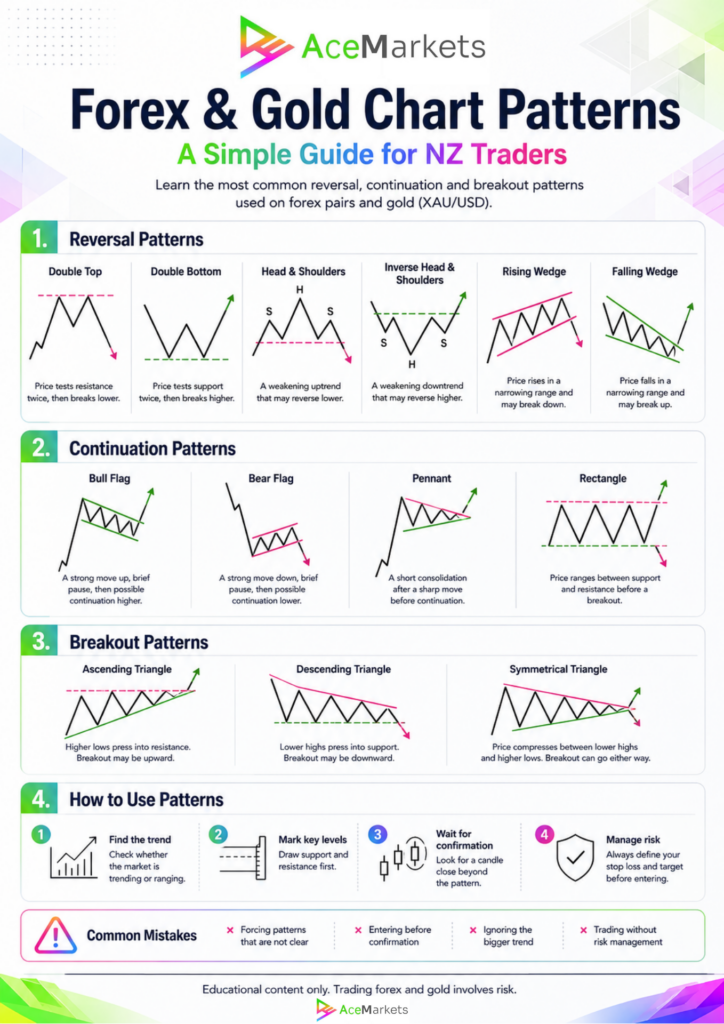
Quick answer: what are forex chart patterns?
Forex chart patterns are shapes that form on a price chart when buyers and sellers repeatedly react around similar levels. Traders use them to identify possible continuation, reversal or breakout setups. Common examples include triangles, flags, wedges, double tops, double bottoms, head and shoulders, and rectangles.
The most useful chart patterns are not just shapes. They show a story:
Price moves strongly.
Price pauses.
Buyers and sellers fight for control.
Price either continues, reverses or breaks out of the range.
That is why patterns are often used with support and resistance, trendlines, candlestick confirmation and risk management.
Chart patterns vs candlestick patterns
Chart patterns and candlestick patterns are related, but they are not exactly the same.
A chart pattern usually forms over many candles. Examples include a triangle, double top, flag or head and shoulders pattern.
A candlestick pattern usually forms over one, two or three candles. Examples include a doji, hammer, engulfing candle or shooting star.
For forex and gold trading, many traders use both together. A chart pattern gives the bigger structure. A candlestick pattern can help confirm the timing.
For example, a trader might identify a falling wedge on XAU/USD, then wait for a strong bullish candle to close above the wedge before considering a long setup.
Why chart patterns matter in forex and gold trading
Forex and gold markets often move in waves. Price trends, pulls back, consolidates, breaks out, reverses and repeats. Chart patterns help traders organise those movements into something easier to read.
They can help you answer questions such as:
Is the current trend still strong?
Is price losing momentum?
Are buyers defending a support zone?
Are sellers rejecting a resistance zone?
Is the market building pressure before a breakout?
Where could a stop loss or invalidation point make sense?
Where might a trader consider taking profit?
Chart patterns are especially useful for traders who want to make decisions based on price action rather than relying only on indicators.
The three main types of forex chart patterns
Most trading patterns fit into three groups.
1. Continuation patterns
A continuation pattern suggests the market may continue in the same direction after a pause. These patterns usually form during a trend.
Common continuation patterns include:
Bull flags
Bear flags
Pennants
Ascending triangles
Descending triangles
Rectangles
Some wedge patterns
Example: If EUR/USD is in an uptrend and forms a bull flag, some traders will watch for a breakout above the flag as a possible continuation signal.
2. Reversal patterns
A reversal pattern suggests the current trend may be weakening and price could turn in the opposite direction.
Common reversal patterns include:
Double tops
Double bottoms
Head and shoulders
Inverse head and shoulders
Rounding tops
Rounding bottoms
Some wedge patterns
Example: If gold has been rising and forms a double top near resistance, traders may watch for a break below the neckline as a possible bearish reversal signal.
3. Bilateral or breakout patterns
A bilateral pattern shows market indecision. Price is compressing, but the direction is not yet clear. Traders often wait for a confirmed breakout before deciding.
Common bilateral patterns include:
Symmetrical triangles
Rectangles
Tight consolidation ranges
Example: If NZD/USD is moving inside a symmetrical triangle, a trader may prepare for either a bullish or bearish breakout rather than predicting the direction too early.
Before reading any pattern, understand support and resistance
Support and resistance are the foundation of most chart patterns.
Support is an area where buyers have previously stepped in and price has struggled to move lower.
Resistance is an area where sellers have previously stepped in and price has struggled to move higher.
Patterns form when price repeatedly reacts around these areas. A double top forms around resistance. A double bottom forms around support. A triangle forms when support, resistance or trendlines begin to compress price.
Before trading a pattern, ask:
Where is the nearest support?
Where is the nearest resistance?
Is price trending or ranging?
Has price already broken the key level?
Did the candle close beyond the level, or only wick through it?
Where is the trade idea invalidated?
A pattern without context is just a shape. A pattern at a major level is more meaningful.
The most important forex chart patterns for NZ traders
1. Double top pattern
A double top is a bearish reversal pattern. It forms when price reaches a resistance area twice and fails to break higher.
It often looks like the letter M.
How to identify it:
Price is moving upward.
Price hits resistance and pulls back.
Price rises again to a similar level.
Price fails to break higher.
Price breaks below the middle pullback level, known as the neckline.
What it can mean:
Buyers tried twice to push price higher but could not. Sellers may be gaining control.
How traders often use it:
Some traders wait for price to break below the neckline before considering a short trade. Others wait for price to retest the neckline from below.
Common mistake:
Entering too early before the neckline breaks. Until the neckline breaks, the market may still continue higher.
2. Double bottom pattern
A double bottom is a bullish reversal pattern. It forms when price reaches a support area twice and fails to break lower.
It often looks like the letter W.
How to identify it:
Price is moving downward.
Price hits support and bounces.
Price falls again to a similar level.
Price fails to break lower.
Price breaks above the middle bounce level, known as the neckline.
What it can mean:
Sellers tried twice to push price lower but could not. Buyers may be stepping in.
How traders often use it:
Some traders look for a long setup after price breaks above the neckline. Others wait for a retest of the neckline as support.
Common mistake:
Assuming every second touch of support is a double bottom. The pattern is stronger when price actually breaks the neckline.
3. Head and shoulders pattern
The head and shoulders pattern is a bearish reversal pattern. It can appear after an uptrend and may signal that buyers are losing momentum.
How to identify it:
Price forms a first peak, called the left shoulder.
Price forms a higher peak, called the head.
Price forms a lower peak, called the right shoulder.
The lows between the peaks create a neckline.
Price breaks below the neckline.
What it can mean:
The market made one final higher high, then failed to repeat that strength. The lower right shoulder suggests weakening buyer pressure.
How traders often use it:
Some traders consider a short setup after the neckline breaks. A common target method is to measure the distance from the head to the neckline and project it downward from the break.
Common mistake:
Forcing the pattern. A head and shoulders should be clear enough that another trader can see it without needing too much explanation.
4. Inverse head and shoulders pattern
The inverse head and shoulders pattern is a bullish reversal pattern. It can appear after a downtrend and may signal that sellers are losing control.
How to identify it:
Price forms a first low, called the left shoulder.
Price forms a lower low, called the head.
Price forms a higher low, called the right shoulder.
The highs between the lows create a neckline.
Price breaks above the neckline.
What it can mean:
Sellers pushed price to a new low, but then failed to keep pushing lower. Buyers may be gaining strength.
How traders often use it:
Some traders watch for a breakout above the neckline, then consider a long setup if the breakout holds.
Common mistake:
Ignoring the broader trend. If the market is strongly bearish, an inverse head and shoulders may fail unless there is enough confirmation.
5. Ascending triangle pattern
An ascending triangle is usually considered a bullish pattern, especially when it forms during an uptrend.
How to identify it:
Price keeps hitting a similar resistance level.
Pullbacks become shallower.
The lows form a rising trendline.
Price becomes compressed between flat resistance and rising support.
What it can mean:
Buyers are becoming more aggressive because they are willing to buy at higher lows. Sellers are still defending resistance, but pressure is building.
How traders often use it:
Some traders look for a bullish breakout above resistance. Others wait for a retest of the broken resistance level as support.
Common mistake:
Buying inside the triangle without waiting for a breakout. Price can still reject resistance and fall back.
6. Descending triangle pattern
A descending triangle is usually considered a bearish pattern, especially when it forms during a downtrend.
How to identify it:
Price keeps hitting a similar support level.
Bounces become weaker.
The highs form a falling trendline.
Price becomes compressed between flat support and falling resistance.
What it can mean:
Sellers are becoming more aggressive because they are selling at lower highs. Buyers are defending support, but pressure is building.
How traders often use it:
Some traders look for a bearish breakout below support. Others wait for a retest of the broken support level as resistance.
Common mistake:
Shorting before support breaks. A descending triangle can still bounce if buyers defend the level.
7. Symmetrical triangle pattern
A symmetrical triangle is a compression pattern. It can break either upward or downward, so it is best treated as a breakout setup rather than a prediction.
How to identify it:
Price forms lower highs.
Price forms higher lows.
The trendlines converge.
Volatility compresses as price moves toward the triangle point.
What it can mean:
The market is undecided. Buyers and sellers are both losing range, and pressure is building for a move.
How traders often use it:
Some traders wait for a candle close outside the triangle. Others wait for the breakout and retest.
Common mistake:
Assuming the breakout direction before it happens. With symmetrical triangles, confirmation matters.
8. Bull flag pattern
A bull flag is a bullish continuation pattern. It forms after a strong upward move when price pulls back in a controlled channel.
How to identify it:
Price makes a sharp move upward.
Price then drifts lower or sideways in a small channel.
The pullback is weaker than the original move.
Price breaks above the flag.
What it can mean:
The market may be pausing before continuing higher. Early buyers may be taking profit while new buyers prepare to enter.
How traders often use it:
Some traders consider a long setup when price breaks above the flag structure.
Common mistake:
Confusing a deep reversal with a healthy pullback. A strong bull flag usually does not retrace too much of the original move.
9. Bear flag pattern
A bear flag is a bearish continuation pattern. It forms after a strong downward move when price pulls back upward in a controlled channel.
How to identify it:
Price makes a sharp move downward.
Price then drifts higher or sideways in a small channel.
The pullback is weaker than the original move.
Price breaks below the flag.
What it can mean:
The market may be pausing before continuing lower. Sellers may still be in control.
How traders often use it:
Some traders consider a short setup when price breaks below the flag structure.
Common mistake:
Selling too late after price has already completed most of the move. The best setups usually occur close to the breakout, not far after it.
10. Pennant pattern
A pennant is a small continuation pattern that forms after a strong move. It looks like a small symmetrical triangle.
How to identify it:
Price makes a strong impulse move.
Price then compresses into a small triangle.
The consolidation is brief compared with the first move.
Price breaks in the direction of the original move.
What it can mean:
The market is pausing briefly before possibly continuing the trend.
How traders often use it:
Some traders look for a breakout from the pennant in the same direction as the prior move.
Common mistake:
Using pennants in slow, choppy markets. Pennants are usually more meaningful after a strong impulse move.
11. Rising wedge pattern
A rising wedge forms when price moves higher inside two upward-sloping trendlines, but the range becomes tighter. It is often treated as a bearish reversal or bearish continuation pattern, depending on context.
How to identify it:
Price is moving upward.
Higher highs and higher lows continue forming.
The trendlines slope upward and converge.
Momentum appears to weaken.
What it can mean:
Buyers are still pushing price up, but with less force. The market may be vulnerable to a downside break.
How traders often use it:
Some traders watch for price to break below the lower wedge trendline before considering a short setup.
Common mistake:
Shorting only because price is inside a rising wedge. The break of structure is the important part.
12. Falling wedge pattern
A falling wedge forms when price moves lower inside two downward-sloping trendlines, but the range becomes tighter. It is often treated as a bullish reversal or bullish continuation pattern, depending on context.
How to identify it:
Price is moving downward.
Lower highs and lower lows continue forming.
The trendlines slope downward and converge.
Selling momentum appears to weaken.
What it can mean:
Sellers are still pushing price down, but with less strength. The market may be vulnerable to an upside break.
How traders often use it:
Some traders watch for price to break above the upper wedge trendline before considering a long setup.
Common mistake:
Buying too early while price is still making lower lows inside the wedge.
13. Rectangle pattern
A rectangle pattern forms when price moves sideways between support and resistance.
How to identify it:
Price repeatedly bounces from support.
Price repeatedly rejects from resistance.
The range is relatively clear.
Price eventually breaks above resistance or below support.
What it can mean:
The market is consolidating. Buyers and sellers are balanced until one side wins.
How traders often use it:
Range traders may buy near support and sell near resistance. Breakout traders may wait for price to close outside the rectangle.
Common mistake:
Entering a breakout trade on a wick only. A candle close outside the range can reduce the chance of reacting to a false breakout.
14. Cup and handle pattern
The cup and handle is a bullish continuation pattern. It is more common in shares and longer-term charts, but traders may still watch for it on forex and gold when the structure is clear.
How to identify it:
Price forms a rounded base, known as the cup.
Price pulls back slightly, forming the handle.
Price breaks above the handle resistance.
What it can mean:
The market has recovered from a decline, paused, and may be preparing to continue higher.
How traders often use it:
Some traders watch for a breakout above the handle resistance.
Common mistake:
Calling every rounded bottom a cup and handle. The handle should be a controlled pullback, not a full reversal.
Best patterns for gold trading
Gold, commonly watched as XAU/USD, can move quickly when volatility rises. This means patterns on gold can be useful, but false breakouts can also be common.
Patterns many gold traders watch include:
Triangles
Flags
Wedges
Double tops
Double bottoms
Head and shoulders
Rectangles
For gold, it can be helpful to watch the higher timeframe first. A bullish pattern on a 15-minute chart may be less convincing if the 4-hour chart is sitting directly under major resistance.
A simple top-down process is:
Check the daily or 4-hour trend.
Mark major support and resistance.
Move to the lower timeframe for the pattern.
Wait for confirmation.
Plan the stop loss before the entry.
Avoid chasing after a fast breakout candle.
Best patterns for forex pairs
Forex pairs often respond well to structure because traders around the world watch similar levels. Major pairs and NZD pairs can form clean patterns, especially around liquid trading sessions.
Patterns many forex traders watch include:
Ascending triangles
Descending triangles
Symmetrical triangles
Bull flags
Bear flags
Double tops
Double bottoms
Head and shoulders
Rectangles
For NZ traders, pairs such as NZD/USD, AUD/USD, EUR/USD, GBP/USD, USD/JPY and XAU/USD may all display chart patterns. The pattern is only one part of the decision. Spread, volatility, news events and risk management matter too.
How to trade forex chart patterns step by step
Step 1: Start with the higher timeframe
Begin with the daily, 4-hour or 1-hour chart. Identify whether the market is trending, ranging or highly choppy.
A pattern that agrees with the higher timeframe trend may have a cleaner setup than a pattern fighting against it.
Step 2: Mark support and resistance
Draw the obvious levels first. Keep your chart clean. The best levels are usually the ones price has reacted to multiple times.
Avoid drawing too many lines. Too many levels can make every movement look important.
Step 3: Identify the pattern
Look for a clear structure. If you need to force the pattern, skip it.
Ask:
Is this a continuation, reversal or breakout pattern?
Is the pattern forming at an important level?
Is price compressing, rejecting or losing momentum?
Is the pattern visible on more than one timeframe?
Step 4: Wait for confirmation
Confirmation can include:
A candle close beyond the pattern boundary.
A retest of the broken level.
A strong rejection candle.
A higher low after a bullish breakout.
A lower high after a bearish breakout.
Confirmation does not remove risk. It simply helps avoid entering too early.
Step 5: Define the invalidation point
Before entering, decide where the trade idea is wrong.
For a bullish breakout, the invalidation point may be below the breakout level, below the most recent swing low or below the pattern.
For a bearish breakout, the invalidation point may be above the breakout level, above the most recent swing high or above the pattern.
This helps you place a logical stop loss instead of guessing.
Step 6: Plan the target
Common target methods include:
The next support or resistance level.
The height of the pattern projected from the breakout.
A fixed risk-to-reward target.
Partial profit at the first key level and a runner for the rest.
Targets should be realistic. If the target sits directly beyond a major support or resistance zone, price may struggle to reach it.
Step 7: Manage the trade
Once in the trade, avoid changing the plan emotionally.
Some traders move the stop loss to reduce risk after price moves in their favour. Others take partial profits at key levels. The right approach depends on your trading plan, timeframe and risk tolerance.
The key is consistency.
Example: how a trader might read a gold triangle
Imagine XAU/USD has been trending upward on the 4-hour chart. Price then starts forming lower highs and higher lows, creating a symmetrical triangle.
A beginner might guess the next direction. A more structured trader would wait.
The process could look like this:
The higher timeframe trend is upward.
The triangle shows compression.
Resistance is marked along the lower highs.
Support is marked along the higher lows.
Price closes above the triangle resistance.
The trader waits for a retest or confirmation candle.
The stop loss is planned below the breakout area.
The target is planned near the next resistance zone.
This does not mean the trade will win. It simply shows how a pattern can become a structured trade idea instead of an emotional reaction.
How to avoid false breakouts
False breakouts happen when price moves beyond a pattern level, attracts traders into the move, then quickly reverses.
They are common in forex and gold.
To reduce the chance of reacting to a false breakout:
Wait for a candle close beyond the level.
Watch whether price retests the broken level.
Avoid entering after a very extended candle.
Check whether major news is about to be released.
Use higher timeframe support and resistance.
Keep position size controlled.
Avoid trading every pattern you see.
A false breakout is not always a failure. Sometimes it provides useful information. If price breaks above resistance and immediately falls back below it, that can show rejection and possible seller strength.
Common mistakes beginner traders make with chart patterns
Mistake 1: Forcing patterns onto the chart
Not every market movement is a pattern. If the structure is messy, it is better to wait.
Mistake 2: Entering before confirmation
Many patterns fail before they complete. A triangle is not a breakout until price actually breaks out. A double top is not confirmed until the neckline breaks.
Mistake 3: Ignoring the bigger trend
A bullish pattern against a strong downtrend may fail quickly. Always check the higher timeframe.
Mistake 4: Forgetting about risk management
A good pattern can still lose. The quality of the setup does not remove the need for a stop loss, position sizing and a clear plan.
Mistake 5: Trading during major news without a plan
Forex and gold can move sharply around central bank decisions, inflation data, employment reports and geopolitical events. Patterns can break unexpectedly during high-impact news.
Mistake 6: Chasing price after the move has already happened
If price has already broken out and moved far from the pattern, the risk-to-reward may no longer make sense.
Mistake 7: Using too many indicators
Indicators can help, but too many can create confusion. Start with price structure, support, resistance and trend direction.
Simple chart pattern checklist
Before taking a pattern-based trade, ask:
What market am I trading?
What timeframe am I using?
Is the market trending or ranging?
Where are support and resistance?
What pattern is forming?
Is it a continuation, reversal or breakout pattern?
Has price confirmed the pattern?
Where is my stop loss?
Where is my target?
What is my risk-to-reward?
Is there major news coming?
Does this trade fit my plan?
If you cannot answer these questions, the setup may not be ready.
Chart patterns summary table
| Pattern | Type | Usual signal | Best used when |
|---|---|---|---|
| Double top | Reversal | Bearish | After an uptrend near resistance |
| Double bottom | Reversal | Bullish | After a downtrend near support |
| Head and shoulders | Reversal | Bearish | After an uptrend loses momentum |
| Inverse head and shoulders | Reversal | Bullish | After a downtrend loses momentum |
| Ascending triangle | Continuation or breakout | Often bullish | Price makes higher lows into resistance |
| Descending triangle | Continuation or breakout | Often bearish | Price makes lower highs into support |
| Symmetrical triangle | Breakout | Either direction | Price compresses before a move |
| Bull flag | Continuation | Bullish | After a strong upward move |
| Bear flag | Continuation | Bearish | After a strong downward move |
| Pennant | Continuation | Same as prior move | After a sharp impulse move |
| Rising wedge | Reversal or continuation | Often bearish | Momentum weakens while price rises |
| Falling wedge | Reversal or continuation | Often bullish | Momentum weakens while price falls |
| Rectangle | Range or breakout | Either direction | Price moves between clear levels |
| Cup and handle | Continuation | Often bullish | After rounded recovery and controlled pullback |
Are chart patterns enough on their own?
Chart patterns are useful, but they should not be used alone.
A stronger trading decision may include:
Pattern structure
Support and resistance
Trend direction
Candlestick confirmation
Market volatility
Upcoming news
Risk-to-reward
Position sizing
A written trading plan
The goal is not to find a perfect pattern. The goal is to build a repeatable decision-making process.
Practise chart patterns before trading live
The best way to learn patterns is to mark them on charts repeatedly.
Start with historical charts. Look for clean examples of triangles, flags, double tops and double bottoms. Then move to live charts and practise identifying patterns before they complete.
You can also save screenshots and build your own pattern library. Over time, this helps you recognise which patterns you understand best and which ones you should avoid.
With Ace Markets, eligible New Zealand traders can access gold and forex pairs and practise applying chart pattern analysis to real market charts. Start slowly, focus on education first and make risk management part of every setup. Mastering the MT5 platform can be a big help in reducing potential mistakes, too.
Summing Up Trading Patterns
Forex chart patterns help NZ traders understand price action in a more structured way. They can show when a trend is pausing, when momentum is weakening, when price is compressing and when a breakout may be forming.
The most important patterns to learn first are:
Double top
Double bottom
Head and shoulders
Inverse head and shoulders
Ascending triangle
Descending triangle
Symmetrical triangle
Bull flag
Bear flag
Rising wedge
Falling wedge
Rectangle
Once you understand these, the next step is not to trade every pattern. The next step is to build a simple process: identify the trend, mark support and resistance, wait for confirmation, plan your risk and only take setups that fit your trading plan.
Chart patterns are not a shortcut to guaranteed profits. They are a practical way to read market behaviour, prepare trade ideas and make more disciplined decisions.
FAQs
What are forex chart patterns?
Forex chart patterns are shapes that form on currency price charts when buyers and sellers repeatedly react around certain levels. Traders use them to identify possible breakouts, trend continuation or trend reversal.
What is the best chart pattern for forex trading?
There is no single best chart pattern for every trader or market. Many traders start with simple patterns such as double tops, double bottoms, triangles, flags and head and shoulders because they are easier to recognise and understand.
Do chart patterns work for gold trading?
Chart patterns can be applied to gold markets such as XAU/USD, but they do not guarantee results. Gold can be volatile, so traders should use confirmation, higher timeframe analysis and careful risk management.
Are chart patterns the same as candlestick patterns?
No. Chart patterns usually form over many candles, while candlestick patterns usually form over one to three candles. Traders often use chart patterns for structure and candlestick patterns for confirmation.
Which timeframe is best for forex chart patterns?
There is no single best timeframe. Higher timeframes such as the daily, 4-hour and 1-hour charts can help identify major structure. Lower timeframes can help with timing, but they may produce more noise and false signals.
Are chart patterns suitable for beginners?
Yes, beginners can learn chart patterns, but they should start with simple structures and practise on charts before trading live. Double tops, double bottoms, flags and triangles are good starting points.
What is a false breakout?
A false breakout happens when price moves beyond a support, resistance or pattern boundary, then quickly reverses back inside the previous range. Waiting for candle closes and retests can help reduce false breakout risk.
Can NZ traders use chart patterns on NZD/USD?
Yes. NZD/USD can form the same types of patterns as other forex pairs, including triangles, flags, double tops, double bottoms and rectangles. Traders should still consider spread, volatility, trend direction and news events.
Do I need indicators to trade chart patterns?
Indicators are optional. Many traders use chart patterns with support, resistance and price action only. Others add indicators such as moving averages, RSI or MACD for extra confirmation.
Is this trading advice?
No. This guide is general education only. It does not consider your financial situation, goals or risk tolerance. Forex and gold trading involve risk, and you should understand those risks before trading.